The
loony music video Gangnam Style surpassed two billion views on YouTube
this week, making it the most watched clip of all time. At 4:12 minutes,
that equates to more than 140m hours. Today's #Dailychart shows what
humanity could achieve in the time spent watching the Gangnam Style
video http://econ.st/1tEFEZ6
Lesson for Taiwan Firms After Vietnam’s Anti-Chinese Riots: Go Local
Smoke billowing from a Taiwanese furniture factory in Binh Duong.
Agence France-Presse/Getty Images
For the Taiwanese companies whose factories were destroyed in the recent riots in Vietnam, advice from analysts all carries the same tune: think globally, act locally.
Earlier this month, Taiwanese manufacturers became collateral damage
when an anti-China protest sparked by Beijing’s placement of an oil rig
in a part of the South China Sea in which Vietnam also claims ownership
resulted in the destruction of scores of foreign-owned plants. Taiwanese
manufacturers suffered the heaviest blow. According to the island’s
government, more than 200 Taiwanese factories were damaged and at least 18 were set on fire.
While the underpinning cause of the riots is still under
investigation, one theory is that the rioters may have mistaken
Taiwanese factories as Chinese ones. Others suspect that Vietnamese
workers at the Taiwanese plants may have been angry with their managers,
many of whom are Chinese.
For many analysts, the take-home message for the damaged firms isn’t
to beef up security or do more to distinguish themselves from the their
Chinese counterparts; rather, they should create an atmosphere of
collective responsibility by localizing their management team, said
Winston Yu, chairman of accounting and consulting firm KPMG Taiwan.
Since around 2000, a number of Taiwanese companies have moved their
operations from China to Vietnam as Chinese wages rise. And while the
firms brought job opportunities for Vietnamese workers, many also
brought their management staff from China.
The Chinese staff at the Taiwanese factories in Vietnam are far fewer
in number but have greater authority and much higher pay compared with
the Vietnamese workers.
According to James Wang, country manager of Ernst and Young Taiwan, a
Vietnamese supervisor or department manager in a Taiwanese-owned
factory makes $500 a month on average, while local, low-level staff earn
around $150-$200 a month. A Chinese manager at the same plant who
assumes a more senior role, makes $1,300-$1,500, compared with around
$2,000 for a Taiwanese manager.
“The riots rattled Taiwanese investors’ confidence in Vietnam, but
given the country’s affordability, close proximity to the China market,
and a burgeoning domestic demand, pulling out is not an option,” said
Mr. Wang.
Because the geopolitical tensions are expected to linger
and leaving isn’t in the cards, to minimize tension inside the company
Taiwanese companies should restructure their operation style, starting
with becoming more localized, he said.
The benefits of localization goes beyond cost-saving, it also
“creates a sense of stewardship and fosters synergy among the local
hires,” said Mr. Yu.
Feng Tay Group, a major Taiwanese shoe maker whose clients include
Nike, Bauer and Clarks, said it believes its efforts to localize staff
helped its plant in Binh Duong—where two other Taiwanese factories were
burned down—to escape rioters’ wrath. Feng Tay’s plant has one
Vietnamese general manger, several Vietnamese supervisors, and no
Chinese staff.
“Localization has been a top priority for us because we believe it’s a
way to boost morale among the local workers,” said Amy Chen, the
company’s spokeswoman. “Besides, they are usually quite good at their
jobs. – Jenny W. Hsu. Follow her on Twitter @jen1113
While English food typically gets a bad rap, there are
certain things that the English do really well when it comes to eating
and drinking. They invented the Scotch Egg, they eat a lot of pie and
they've made drinking outside part of their daily routine. London is
home to some of the best restaurants in the world, other countries --
especially our own -- are imitating the English gastropub at every turn,
and hearty, simple fair à la the English Sunday Roast is more
fashionable than ever. More and more, the reputation of bad English food
is unfair and outdated.
One basic, important food that the
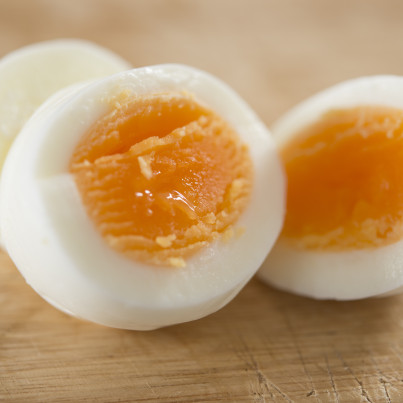
English do right is eggs. English eggs look and taste very different
from American ones. The yolks are more orange and they taste slightly
richer. They also taste fresher and more flavorful than your average
American factory farm egg. (We're not talking free range, organic eggs,
but the kind that come from chickens stacked in tiny cages.) English
eggs are so different than American ones that American eggs would
actually be illegal in the UK -- or anywhere in the EU -- and vice versa.
The
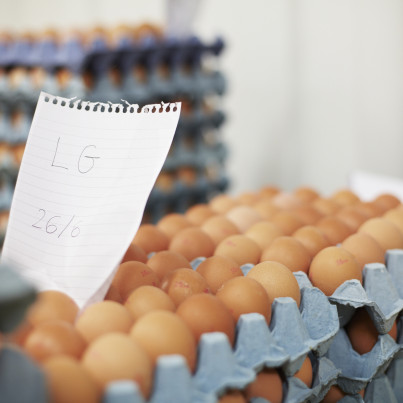
first distinction is that in the U.S., eggs must be washed in order to
be sold commercially. In the UK, however, Grade A eggs -- the kind sold
in supermarkets -- must not be cleaned. This is why you might purchase
eggs with a little bit of grit and even an occasional feather when
you're in the UK. The idea behind the no-wash mandate is that it will
encourage good cultivation on farms. "It’s in the farmers’ best
interests then to produce the cleanest eggs possible, as no one is going
to buy their eggs if they’re dirty,” Mark Williams, Chief Executive of
the British Egg Industry Council told Forbes.
The
USDA doesn't see it that way. They're concerned with the potential of
fecal matter making it from the farm onto the egg, which, being a porous
object, could transfer micro-organisms inside the egg. Eggs in the
United States must be washed in water a minimum of 90°F. They must then
be sprayed with a chemical sanitizer and dried to remove residual
moisture that might enable bacteria to penetrate the egg shell. If any
moisture is left on the egg, the potential for bacteria is much higher.
The U.S. cleaning methods must be followed closely in order for them to
work. With such a high risk of bacteria if cleaned improperly, the UK
believes cleaning is more trouble than it's worth, Forbes explains.
Careless cleaning would be worse than no cleaning.
There is also a thin layer called the cuticle that naturally protects the egg, and the EU egg marketing regulations
prohibit cleaning eggs in order to keep the cuticle intact. The cuticle
protects from contamination and should be left on, they say.
Due
to the different washing philosophies, the U.S. and UK also have
different storage procedures. If you've ever bought eggs in Europe, you
might have noticed that eggs are not refrigerated in the supermarket. In
the U.S., however, eggs are always kept in the refrigerated
section of the grocery store. The different methods stem from the
different washing methods, and more specifically, the potential for
moisture on the egg. In the UK, there is the worry that refrigerating
eggs before consumers take them home will lead to a change of
temperature drastic enough during transportation to cause moisture to
collect. If eggs sweat when moved from a cold fridge to a warm car, for
example, unnecessary bacteria could form.
Finally, there is the concern of salmonella -- in the U.S., we are instructed to keep eggs in temperatures lower than 40°F
because it decreases the risk of salmonella from spreading. In the UK,
salmonella isn't a widespread concern because British farmers have been
vaccinating their hens against salmonella since the 1990s. While the
"drop in salmonella infections in Britain was stunning," according to
the New York Times,
the FDA has not yet mandated vaccination here in the U.S. Vaccination
isn't required by law by in UK either, but necessary if farmers want the
red stamp of approval denoting their hens have been vaccinated.
The
different washing and storing methods must affect the taste of the
eggs, because if you've ever eaten an egg in England, it tastes pretty
different! Have you ever had eggs from the UK? Could you taste the
difference? Let us know!